Triplanetary
A United States Midshipman in China
The Antelope Boy
The Portrait of a Lady Vol II
The Dazzling Miss Davison
The Chessmen of Mars
A Man Awakens in a Strange and Troubled Future
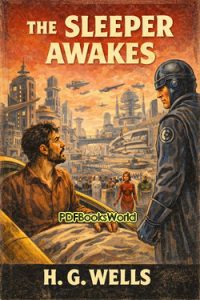
The Sleeper AwakesbyH. G. Wellsis a visionary science fiction novel that explores wealth, political power, technology, and social inequality in a distant future. The story follows Graham, an ordinary man from the nineteenth century who falls into a mysterious sleep and awakens hundreds of years later in a transformed world where he unknowingly controls enormous wealth and influence.
Through this unusual premise, Wells examines how technology and concentrated power can reshape society while also raising questions about freedom, control, and the human cost of modernization.
A Future Built on Wealth and Control
When Graham awakens, he discovers that his money has grown over centuries into a vast economic empire. In this futuristic society, his fortune gives him legal ownership over industries, systems, and institutions that influence everyday life.
However, Graham quickly realizes that powerful political groups are secretly controlling society in his name while ordinary citizens struggle under systems of inequality and social manipulation.
A World Dominated by Technology
The future city imagined by Wells is filled with advanced transportation, towering buildings, artificial lighting, and organized systems controlling labor and entertainment. The world appears impressive and modern, but beneath its technological brilliance lies social unrest and emotional emptiness.
Wells presents technology as both fascinating and dangerous. Scientific progress has increased efficiency and power, yet it has not solved deeper human problems.
Characters
Graham– A man from the past struggling to understand a future societyPolitical leaders manipulating power behind the scenesWorkers and ordinary citizens affected by social inequalityRebels seeking freedom from authoritarian controlCharacters representing ambition, corruption, and resistance
The characters reveal different responses to power, technology, and social change.
Themes
The concentration of wealth and political authorityThe dangers of technological control over societySocial inequality and class divisionThe conflict between freedom and authoritarian powerThe emotional isolation of modern civilization
These themes give the novel both futuristic excitement and strong political relevance.
H. G. Wells’s Visionary Imagination
Long before modern skyscrapers, global media systems, and advanced urban technology became common, Wells imagined a world shaped by large-scale industrial and technological development.
His descriptions of future cities, rapid transportation, and mass entertainment reveal his remarkable ability to anticipate aspects of modern urban life while also questioning their social consequences.
A Critique of Modern Society
Beneath its futuristic setting,The Sleeper Awakesfunctions as a critique of capitalism, political manipulation, and social inequality. Wells warns that technological progress alone cannot guarantee justice or happiness.
The novel suggests that societies focused entirely on wealth and efficiency may sacrifice individuality, freedom, and emotional well-being.
Why the Novel Still Feels Relevant Today
The Sleeper Awakesremains fascinating because many of its concerns continue to resonate in modern discussions about technology, corporate influence, surveillance, and economic inequality.
For readers interested in dystopian fiction, speculative futures, and socially conscious science fiction, the novel offers a compelling exploration of how progress and power can shape the future of humanity.
THE SLEEPER AWAKES
A Revised Edition of “When the Sleeper Wakes”
By H.G. Wells
1899
PREFACE TO THE NEW EDITION
When the Sleeper Wakes
, whose title I have now altered to
The Sleeper Awakes
, was first published as a book in 1899 after a serial appearance in the
Graphic
and one or two American and colonial periodicals. It is one of the most ambitious and least satisfactory of my books, and I have taken the opportunity afforded by this reprinting to make a number of excisions and alterations. Like most of my earlier work, it was written under considerable pressure; there are marks of haste not only in the writing of the latter part, but in the very construction of the story. Except for certain streaks of a slovenliness which seems to be an almost unavoidable defect in me, there is little to be ashamed of in the writing of the opening portion; but it will be fairly manifest to the critic that instead of being put aside and thought over through a leisurely interlude, the ill-conceived latter part was pushed to its end. I was at that time overworked, and badly in need of a holiday. In addition to various necessary journalistic tasks, I had in hand another book,
Love and Mr. Lewisham
, which had taken a very much stronger hold upon my affections than this present story. My circumstances demanded that one or other should be finished before I took any rest, and so I wound up the Sleeper sufficiently to make it a marketable work, hoping to be able to revise it before the book printers at any rate got hold of it. But fortune was against me. I came back to England from Italy only to fall dangerously ill, and I still remember the impotent rage and strain of my attempt to put some sort of finish to my story of Mr. Lewisham, with my temperature at a hundred and two. I couldn’t endure the thought of leaving that book a fragment. I did afterwards contrive to save it from the consequences of that febrile spurt—
Love and Mr. Lewisham
is indeed one of my most carefully balanced books—but the Sleeper escaped me.
It is twelve years now since the Sleeper was written, and that young man of thirty-one is already too remote for me to attempt any very drastic reconstruction of his work. I have played now merely the part of an editorial elder brother: cut out relentlessly a number of long tiresome passages that showed all too plainly the fagged, toiling brain, the heavy sluggish
driven
pen, and straightened out certain indecisions at the end. Except for that, I have done no more than hack here and there at clumsy phrases and repetitions. The worst thing in the earlier version, and the thing that rankled most in my mind, was the treatment of the relations of Helen Wotton and Graham. Haste in art is almost always vulgarisation, and I slipped into the obvious vulgarity of making what the newspaper syndicates call a “love interest” out of Helen. There was even a clumsy intimation that instead of going up in the flying-machine to fight, Graham might have given in to Ostrog, and married Helen. I have now removed the suggestion of these uncanny connubialities. Not the slightest intimation of any sexual interest could in truth have arisen between these two. They loved and kissed one another, but as a girl and her heroic grandfather might love, and in a crisis kiss. I have found it possible, without any very serious disarrangement, to clear all that objectionable stuff out of the story, and so a little ease my conscience on the score of this ungainly lapse. I have also, with a few strokes of the pen, eliminated certain dishonest and regrettable suggestions that the People beat Ostrog. My Graham dies, as all his kind must die, with no certainty of either victory or defeat.
Who will win—Ostrog or the People? A thousand years hence that will still be just the open question we leave to-day.
H.G. WELLS.
He was no longer in the hall. He was marching along a gallery overhanging one of the great streets of the moving platforms that traversed the city. Before him and behind him tramped his guards. The wh…
He was startled by a cough close at hand. He turned sharply, and peering, saw a small, hunched-up figure sitting a couple of yards off in the shadow of the enclosure. “Have ye any news?” asked the h…
Graham could now take a clearer view of his position. For a long time yet he wandered, but after the talk of the old man his discovery of this Ostrog was clear in his mind as the final inevitable deci…
So far as Graham was able to judge, it was near midday when the white banner of the Council fell. But some hours had to elapse before it was possible to effect the formal capitulation, and so after he…
And so after strange delays and through an avenue of doubt and battle, this man from the nineteenth century came at last to his position at the head of that complex world. At first when he rose from …
The state apartments of the Wind Vane Keeper would have astonished Graham had he entered them fresh from his nineteenth century life, but already he was growing accustomed to the scale of the new time…
The Flying Stages of London were collected together in an irregular crescent on the southern side of the river. They formed three groups of two each and retained the names of ancient suburban hills or…
Lincoln awaited Graham in an apartment beneath the flying stages. He seemed curious to learn all that had happened, pleased to hear of the extraordinary delight and interest which Graham took in flyin…
She came upon him at last in a little gallery that ran from the Wind-Vane Offices toward his state apartments. The gallery was long and narrow, with a series of recesses, each with an arched fenestrat…
Graham found Ostrog waiting to give a formal account of his day’s stewardship. On previous occasions he had passed over this ceremony as speedily as possible, in order to resume his aerial experiences…

A Thoughtful Novel About Family, Society, and Emotional Growth Lodore, Vol. 1by…
Read more

Adventure, Romance, and Alien Worlds in Thuvia, Maid of Mars Flying ships, myst…
Read more

A Journey Through Prehistoric Humanity A Son of the AgesbyStanley Waterloois a …
Read more