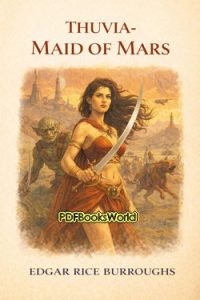
CARTHORIS AND THUVIA
Upon a massive bench of polished ersite beneath the gorgeous blooms of a giant pimalia a woman sat. Her shapely, sandalled foot tapped impatiently upon the jewel-strewn walk that wound beneath the stately sorapus trees across the scarlet sward of the royal gardens of Thuvan Dihn, Jeddak of Ptarth, as a dark-haired, red-skinned warrior bent low toward her, whispering heated words close to her ear.
"Ah, Thuvia of Ptarth," he cried, "you are cold even before the fiery blasts of my consuming love! No harder than your heart, nor colder is the hard, cold ersite of this thrice happy bench which supports your divine and fadeless form! Tell me, O Thuvia of Ptarth, that I may still hope—that though you do not love me now, yet some day, some day, my princess, I—"
The girl sprang to her feet with an exclamation of surprise and displeasure. Her queenly head was poised haughtily upon her smooth red shoulders. Her dark eyes looked angrily into those of the man.
"You forget yourself, and the customs of Barsoom, Astok," she said. "I have given you no right thus to address the daughter of Thuvan Dihn, nor have you won such a right."
The man reached suddenly forth and grasped her by the arm.
"You shall be my princess!" he cried. "By the breast of Issus, thou shalt, nor shall any other come between Astok, Prince of Dusar, and his heart's desire. Tell me that there is another, and I shall cut out his foul heart and fling it to the wild calots of the dead sea-bottoms!"
At touch of the man's hand upon her flesh the girl went pallid beneath her coppery skin, for the persons of the royal women of the courts of Mars are held but little less than sacred. The act of Astok, Prince of Dusar, was profanation. There was no terror in the eyes of Thuvia of Ptarth—only horror for the thing the man had done and for its possible consequences.
"Release me." Her voice was level—frigid.
The man muttered incoherently and drew her roughly toward him.
"Release me!" she repeated sharply, "or I call the guard, and the Prince of Dusar knows what that will mean."
Quickly he threw his right arm about her shoulders and strove to draw her face to his lips. With a little cry she struck him full in the mouth with the massive bracelets that circled her free arm.
"Calot!" she exclaimed, and then: "The guard! The guard! Hasten in protection of the Princess of Ptarth!"
In answer to her call a dozen guardsmen came racing across the scarlet sward, their gleaming long-swords naked in the sun, the metal of their accoutrements clanking against that of their leathern harness, and in their throats hoarse shouts of rage at the sight which met their eyes.
But before they had passed half across the royal garden to where Astok of Dusar still held the struggling girl in his grasp, another figure sprang from a cluster of dense foliage that half hid a golden fountain close at hand. A tall, straight youth he was, with black hair and keen grey eyes; broad of shoulder and narrow of hip; a clean-limbed fighting man. His skin was but faintly tinged with the copper colour that marks the red men of Mars from the other races of the dying planet—he was like them, and yet there was a subtle difference greater even than that which lay in his lighter skin and his grey eyes.
There was a difference, too, in his movements. He came on in great leaps that carried him so swiftly over the ground that the speed of the guardsmen was as nothing by comparison.
Astok still clutched Thuvia's wrist as the young warrior confronted him. The new-comer wasted no time and he spoke but a single word.
"Calot!" he snapped, and then his clenched fist landed beneath the other's chin, lifting him high into the air and depositing him in a crumpled heap within the centre of the pimalia bush beside the ersite bench.
Her champion turned toward the girl. "Kaor, Thuvia of Ptarth!" he cried. "It seems that fate timed my visit well."
"Kaor, Carthoris of Helium!" the princess returned the young man's greeting, "and what less could one expect of the son of such a sire?"
He bowed his acknowledgment of the compliment to his father, John Carter, Warlord of Mars. And then the guardsmen, panting from their charge, came up just as the Prince of Dusar, bleeding at the mouth, and with drawn sword, crawled from the entanglement of the pimalia.
Astok would have leaped to mortal combat with the son of Dejah Thoris, but the guardsmen pressed about him, preventing, though it was clearly evident that naught would have better pleased Carthoris of Helium.
"But say the word, Thuvia of Ptarth," he begged, "and naught will give me greater pleasure than meting to this fellow the punishment he has earned."
"It cannot be, Carthoris," she replied. "Even though he has forfeited all claim upon my consideration, yet is he the guest of the jeddak, my father, and to him alone may he account for the unpardonable act he has committed."
"As you say, Thuvia," replied the Heliumite. "But afterward he shall account to Carthoris, Prince of Helium, for this affront to the daughter of my father's friend." As he spoke, though, there burned in his eyes a fire that proclaimed a nearer, dearer cause for his championship of this glorious daughter of Barsoom.
The maid's cheek darkened beneath the satin of her transparent skin, and the eyes of Astok, Prince of Dusar, darkened, too, as he read that which passed unspoken between the two in the royal gardens of the jeddak.
"And thou to me," he snapped at Carthoris, answering the young man's challenge.
The guard still surrounded Astok. It was a difficult position for the young officer who commanded it. His prisoner was the son of a mighty jeddak; he was the guest of Thuvan Dihn—until but now an honoured guest upon whom every royal dignity had been showered. To arrest him forcibly could mean naught else than war, and yet he had done that which in the eyes of the Ptarth warrior merited death.
The young man hesitated. He looked toward his princess. She, too, guessed all that hung upon the action of the coming moment. For many years Dusar and Ptarth had been at peace with each other. Their great merchant ships plied back and forth between the larger cities of the two nations. Even now, far above the gold-shot scarlet dome of the jeddak's palace, she could see the huge bulk of a giant freighter taking its majestic way through the thin Barsoomian air toward the west and Dusar.
By a word she might plunge these two mighty nations into a bloody conflict that would drain them of their bravest blood and their incalculable riches, leaving them all helpless against the inroads of their envious and less powerful neighbors, and at last a prey to the savage green hordes of the dead sea-bottoms.
No sense of fear influenced her decision, for fear is seldom known to the children of Mars. It was rather a sense of the responsibility that she, the daughter of their jeddak, felt for the welfare of her father's people.
"I called you, Padwar," she said to the lieutenant of the guard, "to protect the person of your princess, and to keep the peace that must not be violated within the royal gardens of the jeddak. That is all. You will escort me to the palace, and the Prince of Helium will accompany me."
Without another glance in the direction of Astok she turned, and taking Carthoris' proffered hand, moved slowly toward the massive marble pile that housed the ruler of Ptarth and his glittering court. On either side marched a file of guardsmen. Thus Thuvia of Ptarth found a way out of a dilemma, escaping the necessity of placing her father's royal guest under forcible restraint, and at the same time separating the two princes, who otherwise would have been at each other's throat the moment she and the guard had departed.
Beside the pimalia stood Astok, his dark eyes narrowed to mere slits of hate beneath his lowering brows as he watched the retreating forms of the woman who had aroused the fiercest passions of his nature and the man whom he now believed to be the one who stood between his love and its consummation.
As they disappeared within the structure Astok shrugged his shoulders, and with a murmured oath crossed the gardens toward another wing of the building where he and his retinue were housed.
That night he took formal leave of Thuvan Dihn, and though no mention was made of the happening within the garden, it was plain to see through the cold mask of the jeddak's courtesy that only the customs of royal hospitality restrained him from voicing the contempt he felt for the Prince of Dusar.
Carthoris was not present at the leave-taking, nor was Thuvia. The ceremony was as stiff and formal as court etiquette could make it, and when the last of the Dusarians clambered over the rail of the battleship that had brought them upon this fateful visit to the court of Ptarth, and the mighty engine of destruction had risen slowly from the ways of the landing-stage, a note of relief was apparent in the voice of Thuvan Dihn as he turned to one of his officers with a word of comment upon a subject foreign to that which had been uppermost in the minds of all for hours.
But, after all, was it so foreign?
"Inform Prince Sovan," he directed, "that it is our wish that the fleet which departed for Kaol this morning be recalled to cruise to the west of Ptarth."
As the warship, bearing Astok back to the court of his father, turned toward the west, Thuvia of Ptarth, sitting upon the same bench where the Prince of Dusar had affronted her, watched the twinkling lights of the craft growing smaller in the distance. Beside her, in the brilliant light of the nearer moon, sat Carthoris. His eyes were not upon the dim bulk of the battleship, but on the profile of the girl's upturned face.
"Thuvia," he whispered.
The girl turned her eyes toward his. His hand stole out to find hers, but she drew her own gently away.
"Thuvia of Ptarth, I love you!" cried the young warrior. "Tell me that it does not offend."
She shook her head sadly. "The love of Carthoris of Helium," she said simply, "could be naught but an honour to any woman; but you must not speak, my friend, of bestowing upon me that which I may not reciprocate."
The young man got slowly to his feet. His eyes were wide in astonishment. It never had occurred to the Prince of Helium that Thuvia of Ptarth might love another.
"But at Kadabra!" he exclaimed. "And later here at your father's court, what did you do, Thuvia of Ptarth, that might have warned me that you could not return my love?"
"And what did I do, Carthoris of Helium," she returned, "that might lead you to believe that I DID return it?"
He paused in thought, and then shook his head. "Nothing, Thuvia, that is true; yet I could have sworn you loved me. Indeed, you well knew how near to worship has been my love for you."
"And how might I know it, Carthoris?" she asked innocently. "Did you ever tell me as much? Ever before have words of love for me fallen from your lips?"
"But you MUST have known it!" he exclaimed. "I am like my father—witless in matters of the heart, and of a poor way with women; yet the jewels that strew these royal garden paths—the trees, the flowers, the sward—all must have read the love that has filled my heart since first my eyes were made new by imaging your perfect face and form; so how could you alone have been blind to it?"
"Do the maids of Helium pay court to their men?" asked Thuvia.
"You are playing with me!" exclaimed Carthoris. "Say that you are but playing, and that after all you love me, Thuvia!"
"I cannot tell you that, Carthoris, for I am promised to another."
Her tone was level, but was there not within it the hint of an infinite depth of sadness? Who may say?
"Promised to another?" Carthoris scarcely breathed the words. His face went almost white, and then his head came up as befitted him in whose veins flowed the blood of the overlord of a world.
"Carthoris of Helium wishes you every happiness with the man of your choice," he said. "With—" and then he hesitated, waiting for her to fill in the name.
"Kulan Tith, Jeddak of Kaol," she replied. "My father's friend and Ptarth's most puissant ally."
The young man looked at her intently for a moment before he spoke again.
"You love him, Thuvia of Ptarth?" he asked.
"I am promised to him," she replied simply.
He did not press her. "He is of Barsoom's noblest blood and mightiest fighters," mused Carthoris. "My father's friend and mine—would that it might have been another!" he muttered almost savagely. What the girl thought was hidden by the mask of her expression, which was tinged only by a little shadow of sadness that might have been for Carthoris, herself, or for them both.
Carthoris of Helium did not ask, though he noted it, for his loyalty to Kulan Tith was the loyalty of the blood of John Carter of Virginia for a friend, greater than which could be no loyalty.
He raised a jewel-encrusted bit of the girl's magnificent trappings to his lips.
"To the honour and happiness of Kulan Tith and the priceless jewel that has been bestowed upon him," he said, and though his voice was husky there was the true ring of sincerity in it. "I told you that I loved you, Thuvia, before I knew that you were promised to another. I may not tell you it again, but I am glad that you know it, for there is no dishonour in it either to you or to Kulan Tith or to myself. My love is such that it may embrace as well Kulan Tith—if you love him." There was almost a question in the statement.
"I am promised to him," she replied.
Carthoris backed slowly away. He laid one hand upon his heart, the other upon the pommel of his long-sword.
"These are yours—always," he said. A moment later he had entered the palace, and was gone from the girl's sight.
Had he returned at once he would have found her prone upon the ersite bench, her face buried in her arms. Was she weeping? There was none to see.
Carthoris of Helium had come all unannounced to the court of his father's friend that day. He had come alone in a small flier, sure of the same welcome that always awaited him at Ptarth. As there had been no formality in his coming there was no need of formality in his going.
To Thuvan Dihn he explained that he had been but testing an invention of his own with which his flier was equipped—a clever improvement of the ordinary Martian air compass, which, when set for a certain destination, will remain constantly fixed thereon, making it only necessary to keep a vessel's prow always in the direction of the compass needle to reach any given point upon Barsoom by the shortest route.
Carthoris' improvement upon this consisted of an auxiliary device which steered the craft mechanically in the direction of the compass, and upon arrival directly over the point for which the compass was set, brought the craft to a standstill and lowered it, also automatically, to the ground.
"You readily discern the advantages of this invention," he was saying to Thuvan Dihn, who had accompanied him to the landing-stage upon the palace roof to inspect the compass and bid his young friend farewell.
A dozen officers of the court with several body servants were grouped behind the jeddak and his guest, eager listeners to the conversation—so eager on the part of one of the servants that he was twice rebuked by a noble for his forwardness in pushing himself ahead of his betters to view the intricate mechanism of the wonderful "controlling destination compass," as the thing was called.
"For example," continued Carthoris, "I have an all-night trip before me, as to-night. I set the pointer here upon the right-hand dial which represents the eastern hemisphere of Barsoom, so that the point rests upon the exact latitude and longitude of Helium. Then I start the engine, roll up in my sleeping silks and furs, and with lights burning, race through the air toward Helium, confident that at the appointed hour I shall drop gently toward the landing-stage upon my own palace, whether I am still asleep or no."
"Provided," suggested Thuvan Dihn, "you do not chance to collide with some other night wanderer in the meanwhile."
Carthoris smiled. "No danger of that," he replied. "See here," and he indicated a device at the right of the destination compass. "This is my 'obstruction evader,' as I call it. This visible device is the switch which throws the mechanism on or off. The instrument itself is below deck, geared both to the steering apparatus and the control levers.
"It is quite simple, being nothing more than a radium generator diffusing radio-activity in all directions to a distance of a hundred yards or so from the flier. Should this enveloping force be interrupted in any direction a delicate instrument immediately apprehends the irregularity, at the same time imparting an impulse to a magnetic device which in turn actuates the steering mechanism, diverting the bow of the flier away from the obstacle until the craft's radio-activity sphere is no longer in contact with the obstruction, then she falls once more into her normal course. Should the disturbance approach from the rear, as in case of a faster-moving craft overhauling me, the mechanism actuates the speed control as well as the steering gear, and the flier shoots ahead and either up or down, as the oncoming vessel is upon a lower or higher plane than herself.
"In aggravated cases, that is when the obstructions are many, or of such a nature as to deflect the bow more than forty-five degrees in any direction, or when the craft has reached its destination and dropped to within a hundred yards of the ground, the mechanism brings her to a full stop, at the same time sounding a loud alarm which will instantly awaken the pilot. You see I have anticipated almost every contingency."
Thuvan Dihn smiled his appreciation of the marvellous device. The forward servant pushed almost to the flier's side. His eyes were narrowed to slits.
"All but one," he said.
The nobles looked at him in astonishment, and one of them grasped the fellow none too gently by the shoulder to push him back to his proper place. Carthoris raised his hand.
"Wait," he urged. "Let us hear what the man has to say—no creation of mortal mind is perfect. Perchance he has detected a weakness that it will be well to know at once. Come, my good fellow, and what may be the one contingency I have overlooked?"
As he spoke Carthoris observed the servant closely for the first time. He saw a man of giant stature and handsome, as are all those of the race of Martian red men; but the fellow's lips were thin and cruel, and across one cheek was the faint, white line of a sword-cut from the right temple to the corner of the mouth.
"Come," urged the Prince of Helium. "Speak!"
The man hesitated. It was evident that he regretted the temerity that had made him the centre of interested observation. But at last, seeing no alternative, he spoke.
"It might be tampered with," he said, "by an enemy."
Carthoris drew a small key from his leathern pocket-pouch.
"Look at this," he said, handing it to the man. "If you know aught of locks, you will know that the mechanism which this unlooses is beyond the cunning of a picker of locks. It guards the vitals of the instrument from crafty tampering. Without it an enemy must half wreck the device to reach its heart, leaving his handiwork apparent to the most casual observer."
The servant took the key, glanced at it shrewdly, and then as he made to return it to Carthoris dropped it upon the marble flagging. Turning to look for it he planted the sole of his sandal full upon the glittering object. For an instant he bore all his weight upon the foot that covered the key, then he stepped back and with an exclamation as of pleasure that he had found it, stooped, recovered it, and returned it to the Heliumite. Then he dropped back to his station behind the nobles and was forgotten.
A moment later Carthoris had made his adieux to Thuvan Dihn and his nobles, and with lights twinkling had risen into the star-shot void of the Martian night.
 Library