The Rambler Club's Gold Mine
The Cruise of the Pelican
The Black Tiger
Billy Whiskers Out for Fun
With Sword and Crucifix
The Mysterious Island
A Visionary Science Fiction Novel About War and Humanity’s Future
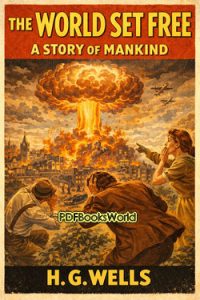
The World Set Free - A Story of MankindbyH. G. Wellsis a groundbreaking science fiction novel that explores the terrifying potential of advanced weapons and the possibility of rebuilding human civilization after global destruction. Written before the invention of nuclear weapons, the novel became famous for imagining atomic bombs decades before they became reality.
Wells combines futuristic speculation with political philosophy and social commentary, creating a story that examines both humanity’s capacity for destruction and its hope for progress. The novel reflects his belief that scientific advancement could either save civilization or push it toward catastrophe.
A Future Changed by Scientific Discovery
The story takes place in a future where scientists develop powerful atomic energy capable of producing devastating weapons. These new bombs create destruction on a scale the world has never seen before.
Unlike traditional explosives, the atomic bombs in the novel continue burning and releasing energy long after detonation. This terrifying idea gives the story a sense of urgency and danger that still feels striking today.
The Destruction of the Old World
Global war breaks out as nations use these terrible weapons against one another. Cities collapse, governments fail, and society descends into chaos.
Wells presents war not as heroic adventure but as evidence of humanity’s inability to control its own inventions responsibly. The destruction forces survivors to reconsider how civilization should be organized in the future.
Characters
Scientists whose discoveries transform the future of warfarePolitical leaders struggling to manage global conflictOrdinary citizens affected by war and social collapseThinkers and reformers seeking a better world after destructionCharacters representing both human ambition and human weakness
The characters reflect Wells’s interest in the relationship between science, politics, and moral responsibility.
Themes
The dangers of uncontrolled scientific progressThe destructive power of war and nationalismThe possibility of global cooperation and peaceHuman responsibility in the use of technologyThe rebuilding of society after catastrophe
These themes give the novel philosophical depth alongside its dramatic futuristic ideas.
H. G. Wells’s Remarkable Prediction of Atomic Weapons
One of the most famous aspects of the novel is Wells’s prediction of atomic warfare long before real nuclear weapons existed. His description of devastating energy-based bombs later appeared surprisingly close to twentieth century technological developments.
This imaginative foresight helped establish Wells as one of the most influential speculative thinkers in modern literature.
A Story About Rebuilding Civilization
Although much of the novel focuses on destruction, Wells ultimately explores hope and reconstruction. After the collapse of old political systems, survivors attempt to create a more peaceful and unified global society.
Wells believed humanity might learn from catastrophe and move toward greater international cooperation and rational governance.
Why the Novel Remains Powerful Today
The World Set Freecontinues to resonate because its warnings about technology, warfare, and global conflict remain deeply relevant. The novel raises important questions about scientific responsibility and humanity’s ability to control dangerous inventions.
For readers interested in classic science fiction, political thought, and futuristic speculation, the novel offers a fascinating and unsettling exploration of destruction, survival, and the future of human civilization.
THE history of mankind is the history of the attainment of external power. Man is the tool-using, fire-making animal. From the outset of his terrestrial career we find him supplementing the natural strength and bodily weapons of a beast by the heat of burning and the rough implement of stone. So he passed beyond the ape. From that he expands. Presently he added to himself the power of the horse and the ox, he borrowed the carrying strength of water and the driving force of the wind, he quickened his fire by blowing, and his simple tools, pointed first with copper and then with iron, increased and varied and became more elaborate and efficient. He sheltered his heat in houses and made his way easier by paths and roads. He complicated his social relationships and increased his efficiency by the division of labour. He began to store up knowledge. Contrivance followed contrivance, each making it possible for a man to do more. Always down the lengthening record, save for a set-back ever and again, he is doing more.... A quarter of a million years ago the utmost man was a savage, a being scarcely articulate, sheltering in holes in the rocks, armed with a rough-hewn flint or a fire-pointed stick, naked, living in small family groups, killed by some younger man so soon as his first virile activity declined. Over most of the great wildernesses of earth you would have sought him in vain; only in a few temperate and sub-tropical river valleys would you have found the squatting lairs of his little herds, a male, a few females, a child or so.
He knew no future then, no kind of life except the life he led. He fled the cave-bear over the rocks full of iron ore and the promise of sword and spear; he froze to death upon a ledge of coal; he drank water muddy with the clay that would one day make cups of porcelain; he chewed the ear of wild wheat he had plucked and gazed with a dim speculation in his eyes at the birds that soared beyond his reach. Or suddenly he became aware of the scent of another male and rose up roaring, his roars the formless precursors of moral admonitions. For he was a great individualist, that original, he suffered none other than himself.
So through the long generations, this heavy precursor, this ancestor of all of us, fought and bred and perished, changing almost imperceptibly.
Yet he changed. That keen chisel of necessity which sharpened the tiger’s claw age by age and fined down the clumsy Orchippus to the swift grace of the horse, was at work upon him—is at work upon him still. The clumsier and more stupidly fierce among him were killed soonest and oftenest; the finer hand, the quicker eye, the bigger brain, the better balanced body prevailed; age by age, the implements were a little better made, the man a little more delicately adjusted to his possibilities. He became more social; his herd grew larger; no longer did each man kill or drive out his growing sons; a system of taboos made them tolerable to him, and they revered him alive and soon even after he was dead, and were his allies against the beasts and the rest of mankind. (But they were forbidden to touch the women of the tribe, they had to go out and capture women for themselves, and each son fled from his stepmother and hid from her lest the anger of the Old Man should be roused. All the world over, even to this day, these ancient inevitable taboos can be traced.) And now instead of caves came huts and hovels, and the fire was better tended and there were wrappings and garments; and so aided, the creature spread into colder climates, carrying food with him, storing food—until sometimes the neglected grass-seed sprouted again and gave a first hint of agriculture.
And already there were the beginnings of leisure and thought.
Man began to think. There were times when he was fed, when his lusts and his fears were all appeased, when the sun shone upon the squatting-place and dim stirrings of speculation lit his eyes. He scratched upon a bone and found resemblance and pursued it and began pictorial art, moulded the soft, warm clay of the river brink between his fingers, and found a pleasure in its patternings and repetitions, shaped it into the form of vessels, and found that it would hold water. He watched the streaming river, and wondered from what bountiful breast this incessant water came; he blinked at the sun and dreamt that perhaps he might snare it and spear it as it went down to its resting-place amidst the distant hills. Then he was roused to convey to his brother that once indeed he had done so—at least that some one had done so—he mixed that perhaps with another dream almost as daring, that one day a mammoth had been beset; and therewith began fiction—pointing a way to achievement—and the august prophetic procession of tales.
For scores and hundreds of centuries, for myriads of generations that life of our fathers went on. From the beginning to the ripening of that phase of human life, from the first clumsy eolith of rudely chipped flint to the first implements of polished stone, was two or three thousand centuries, ten or fifteen thousand generations. So slowly, by human standards, did humanity gather itself together out of the dim intimations of the beast. And that first glimmering of speculation, that first story of achievement, that story-teller bright-eyed and flushed under his matted hair, gesticulating to his gaping, incredulous listener, gripping his wrist to keep him attentive, was the most marvellous beginning this world has ever seen. It doomed the mammoths, and it began the setting of that snare that shall catch the sun.
A recent historical writer has described the world of that time as one that ‘believed in established words and was invincibly blind to the obvious in things.’ Certainly it seems now that nothing could…
But let us return to Frederick Barnet’s Wander Jahre and its account of the experiences of a common man during the war time. While these terrific disclosures of scientific possibility were happening i…
But as yet Barnet had seen no more than the mildest beginnings of modern warfare. So far he had taken part only in a little shooting. The bayonet attack by which the advanced line was broken was made …
‘We had cursed our luck,’ says Barnet, ‘that we could not get to our quarters at Alkmaar that night. There, we were told, were provisions, tobacco, and everything for which we craved. But the main can…
Morning found Barnet still afloat. The bows of his barge had been badly strained, and his men were pumping or baling in relays. He had got about a dozen half-drowned people aboard whose boat had capsi…
But now our history must part company with Frederick Barnet and his barge-load of hungry and starving men. For a time in western Europe at least it was indeed as if civilisation had come to a final c…
On the mountain-side above the town of Brissago and commanding two long stretches of Lake Maggiore, looking eastward to Bellinzona, and southward to Luino, there is a shelf of grass meadows which is v…
And one at least of those who were called to this conference of governments came to it on foot. This was King Egbert, the young king of the most venerable kingdom in Europe. He was a rebel, and had al…
That conference upon the Brissago meadows was one of the most heterogeneous collections of prominent people that has ever met together. Principalities and powers, stripped and shattered until all thei…
So it was King Egbert talked at Brissago after they had proclaimed the unity of the world. Every evening after that the assembly dined together and talked at their ease and grew accustomed to each oth…

An Exciting Frontier Adventure in the American West In the Rockies with Kit Car…
Read more

An Exciting Jungle Adventure of Revenge, Survival, and Rediscovered Identity Th…
Read more

A Journey Through Prehistoric Humanity A Son of the AgesbyStanley Waterloois a …
Read more