The Efficiency Expert
John Solomon—Supercargo
Great Expectations
A United States Midshipman Afloat
The Return of Tarzan
With Sword and Crucifix
Social Awkwardness and Emotional Complexity Shape Henry James’s Subtle Collection
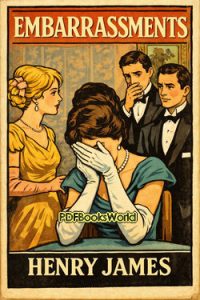
EmbarrassmentsbyHenry Jamesis a sophisticated collection of stories exploring social discomfort, emotional misunderstanding, pride, relationships, and personal uncertainty. Through carefully observed situations and psychologically rich characters, Henry James reveals how ordinary social interactions can become emotionally complicated and deeply revealing.
The stories focus less on dramatic events and more on emotional tension hidden beneath polite conversation and respectable appearances. James examines the awkward moments where social expectation, personal desire, and emotional honesty collide.
The result is an intelligent and emotionally layered collection filled with wit, realism, and psychological insight.
Stories Built Around Human Vulnerability
The stories within the collection feature men and women struggling with emotional insecurity, romantic tension, social pressure, and personal pride. Small misunderstandings or uncomfortable situations often reveal deeper truths about character and relationships.
James carefully shows how embarrassment can expose hidden feelings, emotional weakness, or private longing. What appears socially minor on the surface frequently carries major emotional consequences for the characters involved.
The emotional tension grows quietly through conversation, observation, and internal reflection.
Interesting Character Types Throughout the Collection
Socially Anxious IndividualsCharacters often struggle with reputation, emotional uncertainty, and fear of judgment.Observers and Quiet ThinkersMany protagonists carefully study the emotional behavior of those around them.Emotionally Complicated CouplesRelationships are shaped by misunderstanding, pride, and unspoken feeling.Ambitious and Sensitive FiguresSeveral characters balance social ambition with emotional vulnerability.
The psychological realism of these characters gives the stories emotional depth and lasting appeal.
A Refined and Psychological Writing Style
Henry James writes with elegance and subtlety throughoutEmbarrassments. Emotional conflict develops through small gestures, careful dialogue, and hidden emotional tension rather than dramatic action.
James pays close attention to social behavior and emotional hesitation, allowing readers to interpret feelings beneath the surface of polite conversation. His stories reward careful reading and emotional sensitivity.
The reflective prose creates both intellectual richness and emotional realism.
Main Themes Explored Throughout the Collection
Social Pressure and ReputationCharacters worry deeply about public opinion and social appearance.Emotional MisunderstandingMany conflicts grow from silence, uncertainty, and hidden feeling.Pride and Personal VulnerabilityJames explores how embarrassment reveals emotional weakness and insecurity.Relationships and Human ComplexityThe stories examine the fragile balance between honesty, affection, and social behavior.
These themes make the collection psychologically rich and emotionally engaging.
A Strong Example of Henry James’s Social Fiction
Embarrassmentsdemonstrates Henry James’s extraordinary ability to transform ordinary social situations into emotionally meaningful literary experiences. Small moments of awkwardness or uncertainty become windows into human psychology.
The collection also reflects James’s fascination with social manners, emotional restraint, and the hidden tensions shaping relationships. His characters often feel deeply realistic because they struggle with conflicting emotions and uncertain motives.
The stories remain especially rewarding for readers who enjoy subtle emotional drama and psychological observation.
Why the Collection Still Resonates Today
Even today,Embarrassmentscontinues to appeal because its themes remain highly relatable. Readers still recognize the emotional discomfort created by misunderstanding, social anxiety, and complicated relationships.
The collection also feels modern because of its psychological realism and careful exploration of emotional insecurity. James portrays human vulnerability with remarkable intelligence and sensitivity.
For readers interested in literary classics, psychological fiction, and socially observant short stories, this collection remains elegant, insightful, and rewarding.
I had done a few things and earned a few pence—I had perhaps even had time to begin to think I was finer than was perceived by the patronising; but when I take the little measure of my course (a fidgety habit, for it’s none of the longest yet) I count my real start from the evening George Corvick, breathless and worried, came in to ask me a service. He had done more things than I, and earned more pence, though there were chances for cleverness I thought he sometimes missed. I could only however that evening declare to him that he never missed one for kindness. There was almost rapture in hearing it proposed to me to prepare for
The Middle
_, the organ of our lucubrations, so called from the position in the week of its day of appearance, an article for which he had made himself responsible and of which, tied up with a stout string, he laid on my table the subject. I pounced upon my opportunity—that is on the first volume of it—and paid scant attention to my friend’s explanation of his appeal. What explanation could be more to the point than my obvious fitness for the task? I had written on Hugh Vereker, but never a word in
The Middle
, where my dealings were mainly with the ladies and the minor poets. This was his new novel, an advance copy, and whatever much or little it should do for his reputation I was clear on the spot as to what it should do for mine. Moreover, if I always read him as soon as I could get hold of him, I had a particular reason for wishing to read him now: I had accepted an invitation to Bridges for the following Sunday, and it had been mentioned in Lady Jane’s note that Mr. Vereker was to be there. I was young enough to have an emotion about meeting a man of his renown, and innocent enough to believe the occasion would demand the display of an acquaintance with his “last.”
Corvick, who had promised a review of it, had not even had time to read it; he had gone to pieces in consequence of news requiring—as on precipitate reflection he judged—that he should catch the night-mail to Paris. He had had a telegram from Gwendolen Erme in answer to his letter offering to fly to her aid. I knew already about Gwendolen Erme; I had never seen her, but I had my ideas, which were mainly to the effect that Corvick would marry her if her mother would only die. That lady seemed now in a fair way to oblige him; after some dreadful mistake about some climate or some waters, she had suddenly collapsed on the return from abroad. Her daughter, unsupported and alarmed, desiring to make a rush for home but hesitating at the risk, had accepted our friend’s assistance, and it was my secret belief that at the sight of him Mrs. Erme would pull round. His own belief was scarcely to be called secret; it discernibly at any rate differed from mine. He had showed me Gwendolen’s photograph with the remark that she wasn’t pretty but was awfully interesting; she had published at the age of nineteen a novel in three volumes, “Deep Down,” about which, in
The Middle
, he had been really splendid. He appreciated my present eagerness and undertook that the periodical in question should do no less; then at the last, with his hand on the door, he said to me: “Of course you’ll be all right, you know.” Seeing I was a trifle vague he added: “I mean you won’t be silly.”
“Silly—about Vereker! Why, what do I ever find him but awfully clever?”
“Well, what’s that but silly? What on earth does ‘awfully clever’ mean? For God’s sake try to get
at
him. Don’t let him suffer by our arrangement. Speak of him, you know, if you can, as should have spoken of him.”
I wondered an instant. “You mean as far and away the biggest of the lot—that sort of thing?”
Corvick almost groaned. “Oh, you know, I don’t put them back to back that way; it’s the infancy of art! But he gives me a pleasure so rare; the sense of “—he mused a little—“something or other.”
I wondered again. “The sense, pray, of what?”
“My dear man, that’s just what I want
you
to say!”
Even before Corvick had banged the door I had begun, book in hand, to prepare myself to say it. I sat up with Vereker half the night; Corvick couldn’t have done more than that. He was awfully clever—I stuck to that, but he wasn’t a bit the biggest of the lot. I didn’t allude to the lot, however; I flattered myself that I emerged on this occasion from the infancy of art. “It’s all right,” they declared vividly at the office; and when the number appeared I felt there was a basis on which I could meet the great man; It gave me confidence for a day or two, and then that confidence dropped. I had fancied him reading it with relish, but if Corvick was not satisfied how could Vereker himself be? I reflected indeed that the heat of the admirer was sometimes grosser even than the appetite of the scribe. Corvick at all events wrote me from Paris a little ill-humouredly. Mrs. Erme was pulling round, and I hadn’t at all said what Vereker gave him the sense of.
That’s just half my tale—the extraordinary way it was hindered. This was the fault of a series of accidents; but the accidents continued for years and became, for me and for others, a subject of hilar…
When to crown our long acquaintance I accepted his renewed offer of marriage it was humorously said, I know, that I had made the gift of his photograph a condition. This was so far true that I had ref…
When accordingly at five she presented herself I naturally felt false and base. My act had been a momentary madness, but I had at least to be consistent. She remained an hour; he of course never came;…
In the train the next day this struck me as a good deal for him to have consented to; but my purpose was firm enough to carry me on. I mounted the long hill to where the view begins, and then I knocke…
He broke it presently by saying: “There’s absolutely no doubt of her death?” “Unfortunately none. I’ve just risen from my knees by the bed where they’ve laid her out.” He fixed his eyes hard on the …
It was my theory, my conviction, it became, as I may say, my attitude, that they had still never “met;” and it was just on this ground that I said to myself it would be generous to ask him to stand wi…

A Fast-Paced Science Fiction Thriller of Intrigue and Interstellar Conflict Cos…
Read more

Art, Ambition, and Emotional Struggle in Henry James’s Early Masterpiece Roderi…
Read more

A Journey Through Prehistoric Humanity A Son of the AgesbyStanley Waterloois a …
Read more