Samantha in Europe
Silas Marner
The Bostonians Vol II
A Courier of Fortune
Heart and Science - A Story of the Present Time
Cry Chaos!
A Bold Novel About Freedom, Identity, and Modern Womanhood
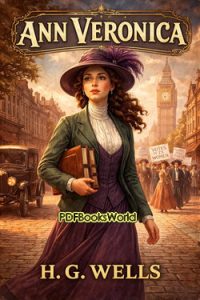
Ann VeronicabyH. G. Wellsis a groundbreaking novel that explores personal independence, social expectations, and the changing role of women in early twentieth century society. The story follows Ann Veronica Stanley, a young woman determined to break free from restrictive traditions and live according to her own beliefs and ambitions.
At the time of its publication, the novel attracted attention for its open discussion of women’s freedom, education, relationships, and personal choice. Wells presents Ann Veronica as an intelligent and independent character struggling against social rules that limit her opportunities and control her future.
A Young Woman Seeking Independence
Ann Veronica begins the story feeling trapped within the expectations imposed by her family and society. Her father represents strict authority and traditional values, while Ann longs for education, freedom, and self-determination.
As the novel progresses, she challenges conventional ideas about gender roles and attempts to create a life based on personal independence rather than obedience.
The Social Changes of the Early Twentieth Century
The novel reflects a period when debates about women’s rights, education, and political participation were becoming increasingly important. Many women were questioning traditional social structures and seeking greater control over their own lives.
Wells uses Ann Veronica’s experiences to explore these broader social transformations and the resistance faced by women pursuing independence.
Characters
Ann Veronica Stanley– A determined young woman seeking freedom and self-expressionMr. Stanley– Her strict father who represents traditional authorityCapes– An intellectual figure who influences Ann’s emotional and personal developmentFriends and social acquaintances reflecting different views on morality and independenceCharacters shaped by the cultural tensions of a changing society
The relationships between the characters reveal the emotional and social pressures connected to personal freedom.
Themes
Women’s independence and self-determinationThe conflict between personal freedom and social expectationEducation and intellectual growthLove, relationships, and emotional autonomyThe changing values of modern society
These themes made the novel both controversial and influential during its time.
H. G. Wells’s Realistic and Progressive Writing Style
Although H. G. Wells is widely known for science fiction novels such asThe Time MachineandThe War of the Worlds,Ann Veronicareveals another side of his writing. The novel focuses on realism, emotional conflict, and social debate rather than futuristic adventure.
Wells writes with clarity and directness, presenting conversations and personal struggles in a way that feels natural and emotionally convincing.
A Novel That Challenged Social Expectations
At the time of publication, the book shocked some readers because of its frank discussion of relationships and women’s freedom. Ann Veronica’s refusal to accept traditional limitations challenged established social attitudes.
The novel became part of wider cultural discussions about gender equality and personal independence during the early modern era.
Why the Novel Still Feels Relevant Today
Ann Veronicacontinues to resonate because its themes of freedom, identity, and social pressure remain meaningful in modern society. The novel explores the universal struggle between individual desire and public expectation.
For readers interested in feminist literature, social realism, and early twentieth century fiction, the novel offers a thoughtful and emotionally engaging portrait of a woman determined to shape her own future.
One Wednesday afternoon in late September, Ann Veronica Stanley came down from London in a state of solemn excitement and quite resolved to have things out with her father that very evening. She had trembled on the verge of such a resolution before, but this time quite definitely she made it. A crisis had been reached, and she was almost glad it had been reached. She made up her mind in the train home that it should be a decisive crisis. It is for that reason that this novel begins with her there, and neither earlier nor later, for it is the history of this crisis and its consequences that this novel has to tell.
She had a compartment to herself in the train from London to Morningside Park, and she sat with both her feet on the seat in an attitude that would certainly have distressed her mother to see, and horrified her grandmother beyond measure; she sat with her knees up to her chin and her hands clasped before them, and she was so lost in thought that she discovered with a start, from a lettered lamp, that she was at Morningside Park, and thought she was moving out of the station, whereas she was only moving in. “Lord!” she said. She jumped up at once, caught up a leather clutch containing notebooks, a fat text-book, and a chocolate-and-yellow-covered pamphlet, and leaped neatly from the carriage, only to discover that the train was slowing down and that she had to traverse the full length of the platform past it again as the result of her precipitation. “Sold again,” she remarked. “Idiot!” She raged inwardly while she walked along with that air of self-contained serenity that is proper to a young lady of nearly two-and-twenty under the eye of the world.
She walked down the station approach, past the neat, obtrusive offices of the coal merchant and the house agent, and so to the wicket-gate by the butcher’s shop that led to the field path to her home. Outside the post-office stood a no-hatted, blond young man in gray flannels, who was elaborately affixing a stamp to a letter. At the sight of her he became rigid and a singularly bright shade of pink. She made herself serenely unaware of his existence, though it may be it was his presence that sent her by the field detour instead of by the direct path up the Avenue.
“Umph!” he said, and regarded his letter doubtfully before consigning it to the pillar-box. “Here goes,” he said. Then he hovered undecidedly for some seconds with his hands in his pockets and his mouth puckered to a whistle before he turned to go home by the Avenue.
Ann Veronica forgot him as soon as she was through the gate, and her face resumed its expression of stern preoccupation. “It’s either now or never,” she said to herself....
Morningside Park was a suburb that had not altogether, as people say, come off. It consisted, like pre-Roman Gaul, of three parts. There was first the Avenue, which ran in a consciously elegant curve from the railway station into an undeveloped wilderness of agriculture, with big, yellow brick villas on either side, and then there was the pavement, the little clump of shops about the post-office, and under the railway arch was a congestion of workmen’s dwellings. The road from Surbiton and Epsom ran under the arch, and, like a bright fungoid growth in the ditch, there was now appearing a sort of fourth estate of little red-and-white rough-cast villas, with meretricious gables and very brassy window-blinds. Behind the Avenue was a little hill, and an iron-fenced path went over the crest of this to a stile under an elm-tree, and forked there, with one branch going back into the Avenue again.
“It’s either now or never,” said Ann Veronica, again ascending this stile. “Much as I hate rows, I’ve either got to make a stand or give in altogether.”
She seated herself in a loose and easy attitude and surveyed the backs of the Avenue houses; then her eyes wandered to where the new red-and-white villas peeped among the trees. She seemed to be making some sort of inventory. “Ye Gods!” she said at last. “WHAT a place!
“Stuffy isn’t the word for it.
“I wonder what he takes me for?”
When presently she got down from the stile a certain note of internal conflict, a touch of doubt, had gone from her warm-tinted face. She had now the clear and tranquil expression of one whose mind is made up. Her back had stiffened, and her hazel eyes looked steadfastly ahead.
As she approached the corner of the Avenue the blond, no-hatted man in gray flannels appeared. There was a certain air of forced fortuity in his manner. He saluted awkwardly. “Hello, Vee!” he said.
“Hello, Teddy!” she answered.
He hung vaguely for a moment as she passed.
But it was clear she was in no mood for Teddys. He realized that he was committed to the path across the fields, an uninteresting walk at the best of times.
“Oh, dammit!” he remarked, “dammit!” with great bitterness as he faced it.
Two days after came the day of the Crisis, the day of the Fadden Dance. It would have been a crisis anyhow, but it was complicated in Ann Veronica’s mind by the fact that a letter lay on the breakfast…
Ann Veronica carried a light but business-like walking-stick. She walked with an easy quickness down the Avenue and through the proletarian portion of Morningside Park, and crossing these fields came …
Her mind got back to the Fadden Ball. She meant to go, she meant to go, she meant to go. Nothing would stop her, and she was prepared to face the consequences. Suppose her father turned her out of do…
Ann Veronica’s ideas of marriage were limited and unsystematic. Her teachers and mistresses had done their best to stamp her mind with an ineradicable persuasion that it was tremendously important, an…
The Gwen affair happened when she was away at school at Marticombe-on-Sea, a term before she went to the High School, and was never very clear to her. Her mother missed writing for a week, and then s…
These were Ann Veronica’s leading cases in the question of marriage. They were the only real marriages she had seen clearly. For the rest, she derived her ideas of the married state from the observed …
“And what are you doing here, young lady,” he said, looking up at her face, “wandering alone so far from home?” “I like long walks,” said Ann Veronica, looking down on him. “Solitary walks?” “That’…
We left Miss Stanley with Ann Veronica’s fancy dress in her hands and her eyes directed to Ann Veronica’s pseudo-Turkish slippers. When Mr. Stanley came home at a quarter to six—an earlier train by f…
Miss Stanley emerged from the study and stood watching Ann Veronica descend. The girl was flushed with excitement, bright-eyed, and braced for a struggle; her aunt had never seen her looking so fine …
There presently came a phase in which she said: “I WON’T stand it even now. I will go to-night.” She went as far as her door, then turned to the window. She opened this and scrambled out—a thing she …

A Suspenseful Tale of Invention, Patriotism, and Dangerous Power Facing the Fla…
Read more

A Family Torn Apart by Desire, Doubt, and Moral Conflict Violence, faith, guilt…
Read more

A Journey Through Prehistoric Humanity A Son of the AgesbyStanley Waterloois a …
Read more